My heritage is German.
On my father’s side, my family is from Fort Wayne, Indiana, as one of a number of families that can be traced back to early settler migrations from central Pennsylvania, and ultimately from southern Germany. But that’s not the really German side.
The really German side is my mother’s. She was born in Germany in 1948 and came to the United States in the 50s, which makes me second generation German-American. (As such, I am also acutely aware of the inherent racism and prejudice that was built into the 20th century quota system, and the privilege my family had in coming from a country that was prioritized over others. However, that is not the focus of this particular post.)
In 1987, I took my first (and so far only) trip to Germany. The main focus of that trip was visiting some of the many relatives we had over there, but we also saw a variety of important landmarks and scenic spots. Obviously some of these were the touristy spots: Köln Cathedral, Rothenburg, Neuschwanstein, and so on. But some were important for other reasons.
Divided Berlin

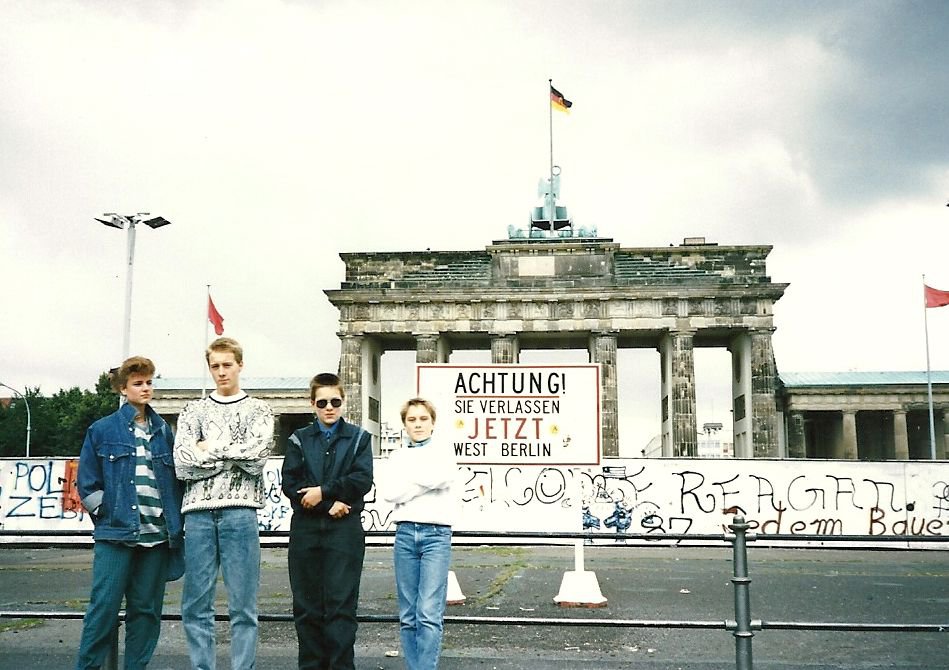
In 1987, we did not yet realize we were in the final years of the Cold War. As far as we knew, conflict with the Eastern Bloc would continue indefinitely. Reagan and Gorbachev would continue sparring until it was someone else’s turn. This is how the world was when my family drove through East Germany to West Berlin. We went there to visit family, but we also visited the Berlin Wall. I have a picture of myself, my brother, and our two cousins standing in front of it, and it’s that picture that I always think of when I think about the Wall. It divided a city, a nation, a culture, a world, but when I was standing there, it was personal.
The West Berlin side of the wall was covered with graffiti. If you’ve ever seen pictures, you know that the tags were a mix of personal statements, artistic statements, and political statements, all in one way or another condemning that symbol of both division and oppression. The Berlin Wall was the most direct physical representation of the Cold War anywhere in the world. No other border so clearly separated East and West both literally and metaphorically, and the fact that the graffiti was only on one side was part of that separation. Graffiti was equated with freedom of expression (a connection I have never forgotten, by the way), so seeing it was a sign that you were on the “right” side.
Nevertheless, standing on the “right” side helped me realize that walls do not make anyone free. It was unsettling to be on the “free” side of the Berlin Wall – certainly to a lesser degree than if we had been stuck in East Berlin, but the discomfort was there nevertheless. The guard towers, the checkpoints, the razor wire: they affected us too. And that’s a concept the United States does not seem to understand. Locking others out always means locking yourself in. Vigilance inevitably means a reduction in your own freedom. And while some may claim that we trade that freedom to gain “safety,” all we really gain is isolation.
The Lessons of Dachau

Because 1987 was still the Cold War, a side trip to Poland wasn’t really an option. So the concentration camp we visited was Dachau. It was important for us to acknowledge and understand our own history. And while Dachau isn’t nearly as famous as Auschwitz, it is a critical piece of understanding fascism – specifically how it grows and takes hold, not just where it can end up. In some ways, forgetting Dachau is how we have ended up where we are today.
I will refer you to the Holocaust Encyclopedia for more detail on Dachau’s history, but there are a few key takeaways for me. First, it began as a prison for supposed “criminals,” specifically political opponents of the regime. It didn’t start out as a place for ethnic and religious cleansing (except that many political opponents of the regime just happened to be Jewish). Also, Dachau was not primarily an extermination camp like Auschwitz was. It was mostly a labor camp. And yes, many were worked to death, and a terrible number of people were executed or experimented on, but the total – and even the percentage – pales in comparison to Auschwitz.
Yet Dachau made every other camp possible. It was the first camp, an early test of the German public’s willingness to accept this kind of mass incarceration. There could not have been an Auschwitz without a Dachau. It was built in 1933, and the world knew what was happening there years before the invasion of Poland caused anyone to seek military intervention. (See, for instance, this political cartoon decrying Britain’s participation in the 1936 Summer Olympics.)
One of the great misunderstandings and misuses of history is to believe or suggest that anything less than Auschwitz is not a concentration camp, that anything less than Auschwitz is not fascism. But Dachau was fascism. It was one of the most important tools for consolidating Nazi power prior to WWII. And we need to see that while many things happening right now may not be Auschwitz, they sure as hell are Dachau.
My Personal Context
If you’ve been paying attention, there are a couple of questions that might be lingering about my family. Yes, my mother was born after the war. But obviously her parents were not. And if I spent weeks visiting family in Germany during the 80s, that means that I must have multiple relatives who were the children of or were themselves German citizens under the Reich. I have spent years pondering that reality and considering what it means.
I could, if I wanted, take comfort in the knowledge that my family members were not enthusiastic participants. We were not perpetrators, collaborators, or opportunists. Some of my relatives were conscripts, but none were volunteers. And I could rest assured that we have learned from our mistakes and our generational guilt at having done even that much. I could find solace in the fact that so many of my relatives eschew hate and violence, maybe in part because of that very guilt.
But I won’t. Because while we were not perpetrators, we were bystanders.
I know this because that is the only thing we could have been. We were not the victims nor the victimizers, yet my family survived. That could not have happened without them keeping their heads down and their concerns private. The very fact that I exist means that I am descended from those who could not or would not resist.
Now, I am not here to berate my ancestors for their inaction. They were afraid and uncertain. They were not wealthy or powerful – they were just normal Germans trying to stay alive, and it would not be productive for me to condemn any of them so long after they have gone. Maybe they did not understand or believe the full implications of everything happening around them until it was too late for them to do anything.
But I have been to Dachau. I have seen the Wall. I know the monumental consequences of inaction in the face of oppression, and I cannot turn away from that knowledge. The true condemnation of my heritage would be for me to ignore its lessons, to deny its responsibility. It is because I am descended from bystanders that I cannot allow myself to be one. At this time, when the signs are clear because they are literally the same, I must stand up in whatever way I can.
It is because I am German that I must resist.
 Eric the Unabridged
