As of this writing, we still have about 100 days until the 2024 US election. Things have been absolutely chaotic, and they’re constantly changing, so it doesn’t really make sense to write a reflective blog post about that. Instead, I want to take a look at broader historical trends to gain a sense of perspective on how we got where we are and some general explanations of the goals of those responsible.
But mostly I want to talk about what it’s like to be able to see big picture possibilities and to have a sense of what’s coming when so many people are distracted by narrow, short-term concerns. I want to talk about the steps that led our democracy into its death spiral and why we let them happen.
Where to Begin?
I could pick pretty much any point in US history to start tracking the mistakes we have made as a nation that led us here. The groundwork for our current crisis (crises, perhaps) was laid in the Constitution itself, and not just the really problematic parts that were eventually amended. The compromises built into the Constitution are profound and far-reaching. They had to be, because the framers had to appease literally everyone or they would continue to be stuck with the horribly broken and un-amendable document that was the Articles of Confederation. In order to make everyone happy (i.e. – “form a more perfect union”), they enshrined the concept of minority rule, the tools for which have caused many of the missteps of democracy throughout US history.
But I want to begin more recently. I want to focus on things that have happened in my lifetime, because that way I can offer my own observations of how people generally reacted to them at the time. My political awareness, and therefore this analysis, begins with the 80s.
The Fairness Doctrine
The Reagan administration was bad for democracy in a variety of ways. Probably the most obvious at the time was its ceaseless assault on labor unions, which began almost immediately. In his second term, however, there was a policy decision that would have a much slower but also more profound effect on American political culture: the revocation of the Fairness Doctrine.
The Fairness Doctrine was an FCC policy that pushed fines and penalties onto broadcast media companies that did not devote substantial time to opposing viewpoints regarding important issues. There was a bit more to it than that, but the important thing to understand is that Reagan’s FCC revoked it. Congress tried to reinstate it immediately, and then again in 1991, but both times it was vetoed – first by Reagan and then by Bush.
However, the average person was not paying much attention at the time. The rise of cable made many broadcast rules feel archaic anyway – relics of the 3-network era. And we didn’t even see much of a change on TV at first. The reliable Rathers and Jennings of the news hour were still there, and people still generally trusted the mainstream news. What did change was more subtle, but it paved the way for the undermining of all American news media: talk radio descended upon an unsuspecting public.
The most immediate and direct effect of the policy change was the rise of Rush Limbaugh. His show, which would have gotten shut down quickly under the Fairness Doctrine, was picked up by Edward F. McLaughlin’s new production company, EFM Radio. McLaughlin offered radio stations the ability to air Limbaugh’s show for free, as long as they reserved a small fraction of the advertising time for national sponsors. Free programming is free programming, and stations jumped at this. And because of Limbaugh’s fiery, opinionated, and now unfettered rhetoric, people tuned in.
Fox News, which launched in the mid-90s, was clearly influenced by Limbaugh’s success. In particular, Rupert Murdoch went even further than Ed McLaughlin and paid cable companies to include Fox News on their rosters. The company’s rapid rise to prominence (passing CNN in less than a decade) can be directly tied to both Murdoch’s massive investment and the absence of the Fairness Doctrine. And while it is also true that the Fairness Doctrine probably could not have survived the birth of the internet as it was, perhaps something should have been put in its place. Without it, we have seen the inevitable decline of trust in news and severe polarization of media.
Bush v. Gore
The 2020 election was certainly not the first presidential election that someone accused of being “rigged” through the use of voting machines (rather than the usual methods of rigging through gerrymandering and voter suppression). 2000 was such a nightmare of confusion and uncertainty for the general public that phrases like “hanging chad” can still cause flashbacks to those of us who lived through it. It became one of the clearest modern examples of judicial activism on the part of the Supreme Court. It was also a clear indicator to those pushing for minority rule that they needed control of the electoral process on a state-by-state level.
The vote counting in Florida for the 2000 election stretched well into December, with both multiple court cases and highly-publicized issues hitting the news regularly. Among these were the infamous “butterfly ballot” issue in Palm Beach County that likely confused thousands of voters into selecting Pat Buchanan instead of Al Gore, and of course the arguments about voter intent based on “hanging” and “dimpled” chads.
With weeks of recounts trending towards Gore, and the Florida Supreme Court ruling in favor of a statewide recount, the Supreme Court took extraordinary measures to step in and act unusually quickly. The Bush campaign had sent in an emergency petition to stay the Florida Court’s decision, and in addition to granting that stay, the Court bypassed procedure by treating the request for a stay as a petition for certiorari. It scheduled oral arguments for two days later (December 11th), and issued its ruling the day after arguments, December 12th, 2000.
The most vocal figure in convincing the other justices to grant the stay, to hear the oral arguments, and to decide ultimately in favor of stopping the recounts – thereby handing Bush the election – was of course Justice Antonin Scalia, who was a longtime friend of Vice Presidential candidate Dick Cheney, Scalia’s involvement and unwillingness to consider recusal in the case was very much a deciding factor, considering the ideological sway he had over other justices. (When Justice Thomas said recently that he had “consulted with colleagues” about reporting gifts, we all knew he meant Scalia.)
The uncharacteristic speed with which the Supreme Court acted in the case raised alarm bells at the time, most notably with the dissenting judges. Justice Stevens wrote in his dissent, “Although we may never know with complete certainty the identity of the winner of this year’s Presidential election, the identity of the loser is perfectly clear. It is the Nation’s confidence in the judge as an impartial guardian of the rule of law.”
And so it has been. Ever since the 2000 election, public faith in voting fairness has decreased and election lawsuits have increased. And the legacy of Scalia hangs like a cloud over the current Supreme Court – a legacy of self-justification of highly personal decisions through the flimsiest claims of constitutionality.
The Patriot Act
For a country so focused on personal freedoms, the US has a long history of not trusting its own citizens. From the Alien and Sedition Acts to the Red Scare, from Japanese-American internment to COINTELPRO, the US frequently finds ways and excuses to use surveillance, imprisonment, and even assassination against its own people. The fear and anger around the September 11th attacks created an environment ripe for such excuses. Congress moved extremely quickly to enact the Uniting and Strengthening America by Providing Appropriate Tools Required to Intercept and Obstruct Terrorism (USA PATRIOT) Act of 2001, and maybe would have enacted it even more quickly if they hadn’t spent time coming up with a ridiculous acronym.
Much of the finger-pointing around the communication failures surrounding 9-11 had focused on the bureaucracies and rivalries that stood between various security agencies, so the Patriot Act’s most publicized function was to smooth the process of information sharing between the CIA, FBI, and NSA. Although the 2001 act did not create the Department of Homeland Security, it paved the way for that later act only two years later.
However, the aspects of the act that were controversial even at the time (to people not completely overwhelmed with xenophobic fervor) were the increased surveillance powers given to those and other agencies. “Potential terrorism” quickly became an easy excuse for the most invasive of secret, warrantless surveillance on US citizens. In particular, although none of the hijackers were US citizens, US security agencies started to conduct regular and aggressive surveillance on mosques throughout the US. These fishing expeditions rarely provided any actionable intelligence on their own, since the few radicalized US citizens that were eventually targeted – such as Anwar al-Awlaki – were already known to be suspicious for a variety of other reasons.
The Patriot Act was reauthorized and extended first by President Bush and then by President Obama. Under Obama, the actions of Edward Snowden turned the public eye on many of the DHS and NSA surveillance practices, so in 2015 it was revised slightly and rebranded as the USA FREEDOM (Uniting and Strengthening America by Fulfilling Rights and Ensuring Effective Discipline Over Monitoring) Act of 2015. Acronyms aside, people still didn’t quite buy it, and the Obama administration let all provisions of both acts expire by 2019.
The damage, however, has been done. Regardless of current legislation, the American public is much more comfortable with surveillance and extra-judicial detainment now than it was 25 years ago, not only on a federal level but on a state and local level as well. More importantly, the 18-year history of these acts showed that both parties are quite willing to use stronger executive powers that are handed to them.
Citizens United v. FEC
Campaign reform legislation has always been a game of catch-up. In 2002, the public was generally favorable of bipartisan legislative action, and it was in this spirit that John McCain and Russ Feingold managed to make solid headway in this effort with their Bipartisan Campaign Reform Act. During the following years, the group Citizens United began to test the limits of this legislation, first by filing complaints about Michael Moore under the law and then by trying to justify making and promoting their own movies.
The particulars of the case that ended up in front of the Supreme Court did not seem to be that far-reaching, having to do only with the promotion of Hillary: the Movie, and initially it seemed like the court was going to have a fairly narrow judgment. However, two things happened that changed that. First, Justice Kennedy convinced Chief Justice Roberts that the decision had not gone far enough, and second, Justice Souter’s dissent reportedly included details on how Roberts had manipulated the Court’s process to engineer a specific outcome. Because of these things, Roberts took the extraordinary measure of setting up a new hearing for the case to be re-argued immediately after Souter’s planned retirement. And if that isn’t a clear example of manipulating the process to engineer an outcome, I don’t know what is.
The Supreme Court’s broader conclusions in the updated opinion destroyed McCain-Feingold and opened the floodgates to corporate money in political campaigns. Furthermore, the Court’s subsequent rejection of a Montana law limiting corporate donations indicated that no legislation at any level could overcome this ruling, effectively reducing campaign finance reform to a question that can only be answered through a Constitutional Amendment. From a practical standpoint, undoing any of the issues with our current electoral process or policy standpoints requires reducing the sway of corporations and wealthy individuals, and that’s nearly impossible as long as Citizens United v. FEC remains intact.
Trump v. United States, and the End of Chevron
In some ways, the two most monumentally disastrous Supreme Court decisions of 2024 were thematically opposed. But that’s only if you isolate them from the context of the specific people they are intended to benefit. What has became clear in the past decade of the Court, however, is that broader historical implications are no longer relevant. The Court is engaged in blatant political manipulation to engineer specific outcomes across the entire country for the purpose of an immediate power grab.
The first decision, Trump v. United States, elevates the office of President to nearly all-powerful. This is the unitary executive theory taken to the extreme. Chief Justice Roberts called Justice Sotomayor’s dissent “fear-mongering” when she suggested that a President could now be immune from prosecution for having political rivals assassinated. Yet only a few weeks later there was a potential test of just that. If the conspiracists had been correct and President Biden had been responsible for the attempt on Trump’s life, this decision would have made him immune from any prosecution other than impeachment. And of course the idea that impeachment is a reasonable remedy for illegal behavior on the part of the President is naïve in both a modern and historical context. Only three presidents have ever been impeached, and none of them were found guilty. It’s an extremely difficult process that would only be made less likely Congress faced actual threats of violence from the very person they were investigating – an almost inevitable outcome.
The second decision with terrible and far-reaching consequences is Loper Bright Enterprises v. Raimondo. The short version of this decision is that it ends the 40-year precedent of “Chevron deference,” which is the assumption that federal agencies have the expertise and authority to determine the meaning of laws that Congress has put in place for their enforcement. Loper takes this power away and puts it in the hands of the courts. And while that might same contrary to the unitary executive theory in that it reduces the direct power of the Executive Branch, it is a gift to corporations, who can now sidestep regulations by seeking out the most advantageous cases in the most industry-friendly districts and having a judge simply reinterpret the law in their favor. The chaos and inconsistency this ruling will engender can only benefit the companies and individuals with the money and legal staffing required to take advantage of such chaos. What it absolutely will not do in any way is benefit the general public.
These two decisions, though superficially different in their attitudes towards the Executive Branch, are united in their support of powerfully wealthy individuals and corporations. And of course one wealthy individual in particular.
Conclusions and the Future
Most of these steps (with the exception of the Patriot Act) took time to accomplish. Setting up these Supreme Court cases required decades of effort on the part of the Federalist Society and its proponents, and of course the pivotal actions of individuals like Mitch McConnell and Antonin Scalia. Because they took so long and were often spread far apart from each other, the average person had time to get used to the “new normal” before the next assault on democracy occurred. But what we failed to realize is that these steps build on each other. We could not be where we are without the gradual accumulation of these and other attacks on our voices and our freedoms.
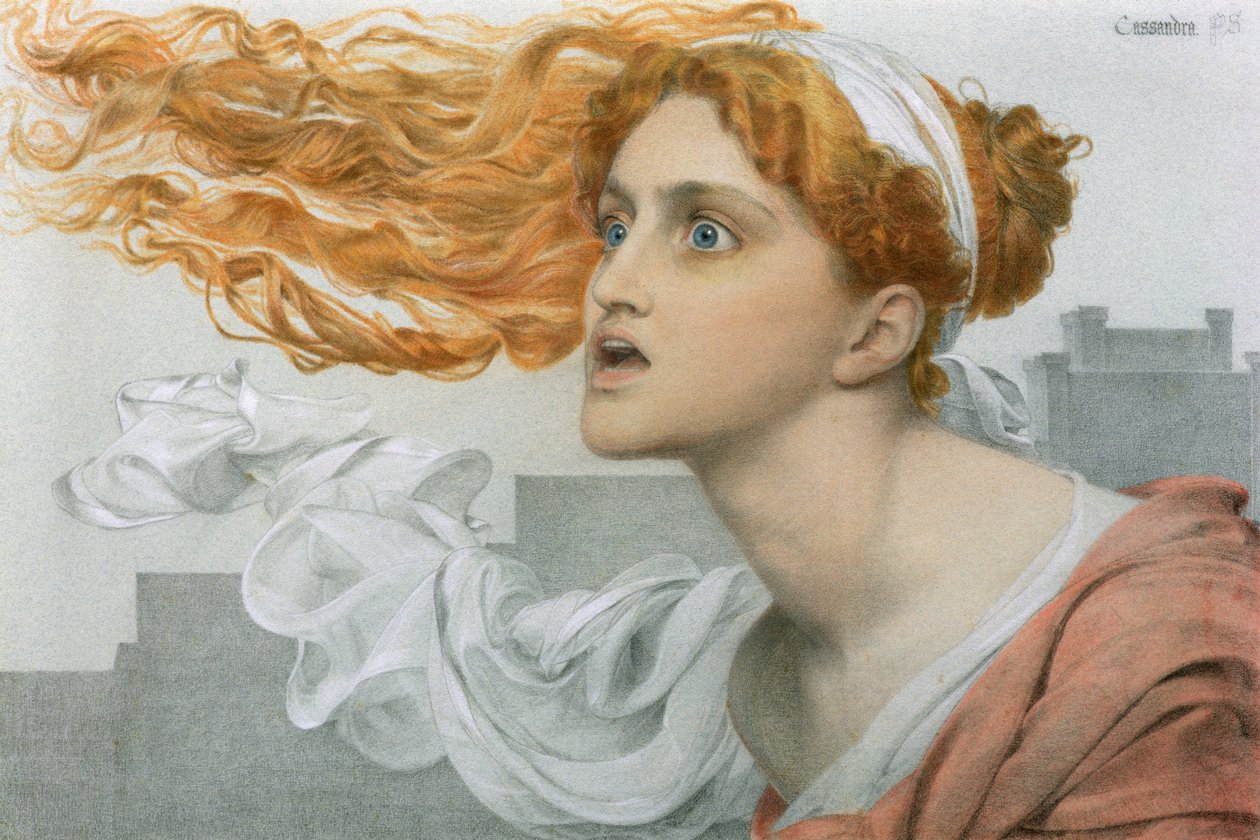
Each time this happened, though, a number of people cried out about what it could mean for the future. But, like Cassandra, they were dismissed as paranoid, exaggerating fear-mongers. And because the fall of democracy didn’t (apparently) happen right away, that seemed correct. So the next time they warned of the dangers, it became easier to dismiss them. But they’re right. They were right every time. It’s just that the fall of democracy comes not from a single trigger but rather a line of dominoes.
So when people point to something like Project 2025 and say that it represents the end of American democracy, maybe listen for once.
Because Cassandra is screaming.
 Eric the Unabridged
One thought on “Cassandra Is Screaming”