Much of the discourse around modern understandings of gender identity, gender expression, biological assignment, sexual attraction, romantic attraction, et al. revolves around the idea of a spectrum. People may try to represent such spectra as scales, grids, Venn diagrams, or even layer cakes. I hear generally positive things about the Gender Unicorn, but I am also a bit wary because of how often these kinds of things are thrown up on the internet with no research or vetting. (Here’s a hilarious article deconstructing a few such diagrams.)
Yet there is value even in flawed representations because of the conversations they generate. They may need to be improved, but their very existence may inspire someone to improve them. And in the meantime we expand our visual and verbal vocabulary for discussing these important concepts of identity, which is always a positive. I believe that increased vocabulary brings increased clarity of communication and thought.
But there is clarity we’re missing, particularly in the category of gender experience and expression.
The Monolithic Masculine
I have talked before about the monolithic perception of masculinity, specifically in the context of roleplaying games, but it pervades our society. A lot of this is because we don’t often talk about the existence of multiple valid ways to experience and express masculinity. In all those models I mentioned above, cis-het-male is a single point, a single experience. But that doesn’t reflect reality.
More importantly, it doesn’t help those who may be trans, demigender, or non-binary to understand the wide variety of experiences and expressions that can all be equally masculine. Instead, we far too often assume that those different experiences are actually non-masculine and therefore to be avoided if one is trying to experience an “authentic” masculinity.
(Before I go any further, I do want to mention that there may also be a similar problem of the monolithic feminine, but I am not qualified to address that. Maybe my work here will inspire someone who is.)
To reject this monolithic understanding of masculinity, I would like to present my model of the masculinity spectrum. It is not researched, it is not technical, and it isn’t even super serious. I hope that it can generate some thought and conversation.
And if you think it sucks, come up with your own and link it in the comments. I just want to start the discussion.
Eric’s Masculinity Spectrum
To begin with, I want to explain that this is not intended to be a spectrum of identity, but rather a spectrum of energy. Expression and experience are active, not static, so I want to convey them as such. More about this below.
In addition, I want it to be clear that I am not expressing something that is scientifically researched – this is entirely pop psychology. I don’t want there to be any danger that someone will take this too seriously. With that in mind, I have built my grid on two axes:
Feelings and Caretaking
Your Feelings energy relates to the ways in which you experience and express your interior self. This includes your emotions, desires, fears, and so on. I divide this into Soft, Playful, Serious, and Hard.
Your Caretaking energy relates to your positive interactions with the world around you. This includes your interactions with people, animals, objects, and events. I divide this into Boy, Bro, Dad, and Gramps.
Each axis has four options, creating a sixteen-box grid (with MCU characters thrown in for flavor) as follows:
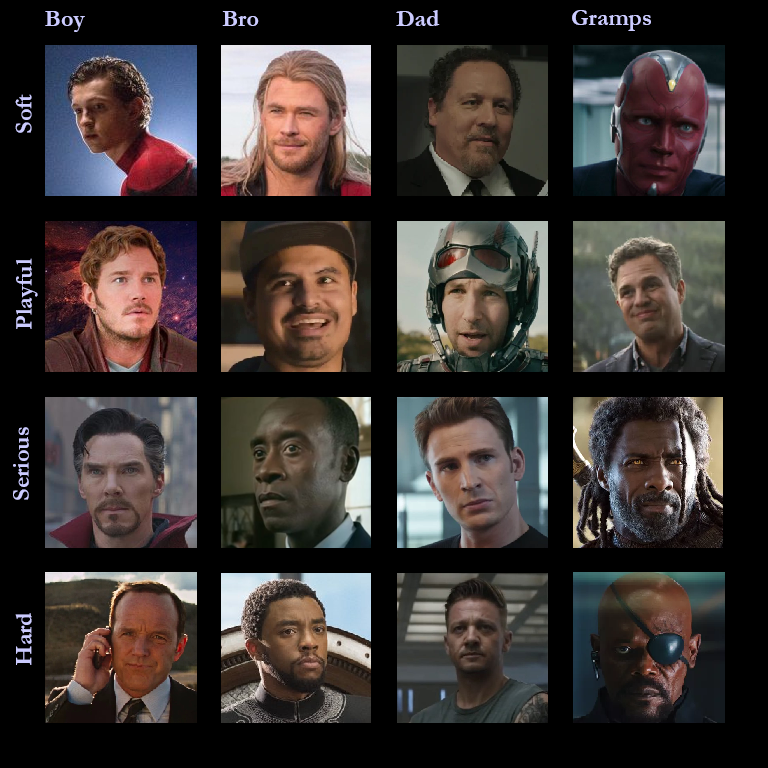
(A couple of notes – Agent Coulson is only a hard boy in the movies. In Agents of S.H.I.E.L.D., he’s all about the hard dad energy. Also, Tony Stark isn’t on here, because he gets multiple arcs throughout the series and doesn’t exist in just one place. No MCU character has gotten as much development as him. Also, Miles Morales is maybe even more of a soft boy than Peter Parker, but I was sticking to the MCU for the moment.)
Now here’s what I mean by each of those:
Feelings
- Soft – Your emotions are open for the world to see. You wear your heart on your sleeve, and you are comfortable expressing and experiencing a broad range of emotions publicly.
- Playful – You like to express joy publicly. If something is fun or awesome, you’ll let people know. You are comfortable sharing your desires when it comes to entertainment and diversion.
- Serious – You like to present an air of productivity and efficiency. You talk frequently about your current goals and past accomplishments. You are comfortable expressing emotions when it is socially appropriate to do so.
- Hard – You are generally seen as quiet or even stoic when it comes to emotions. You know your own heart, but you prefer not to share it with anyone except those closest to you.
Caretaking
- Boy – You’re mostly carefree and here for yourself, not worrying about anyone else. You might have a pet or a collection of some sort, but you don’t take responsibility for other people.
- Bro – You’d do just about anything for your friends and family (whether hereditary or chosen). Whatever your sibs need, you’ll jump in and help. You don’t necessarily feel responsible for them, but you’re there for them.
- Dad – You have a habit of feeling responsible for others, whether it’s because they’re younger or less experienced than you, or because you have a position of relative authority. This attitude often extends beyond your direct family because you enjoy mentoring and guiding others.
- Gramps – You know how to take care of everyone, and you know how they could fix many of their problems, but that’s not your job. ,You might offer some helpful advice if they ask you or if it comes up naturally, but you never feel obligated to do so.
Other Factors
Once you’ve figured out what energy you’re giving out, consider your expression as a vector or trajectory rather than a single point. So, for instance, I am currently doing soft dad but trending towards playful gramps. I occasionally display flashes of playful and gramps despite mostly being a soft dad.
The other thing that I want to point out is that these are all ways to express positive masculinity. None of them are inherently negative. However, there can be toxic versions of any of them. There’s nothing wrong with being a serious bro, as long as you’re careful about being overly competitive in inappropriate contexts. Being aware of the energy you’re giving can help you avoid falling too far into the extremes. Balance is still important.
I hope you enjoyed this attempt at describing something we don’t often see described. I hope that it helps some of you to feel seen and understood in ways you haven’t before. And if it doesn’t, feel free to offer your own definitions. As long as we keep the dialogue going, I’m happy.
Your soft dad,
Eric
 Eric the Unabridged
Reblogged this on Autism Candles.
LikeLike